
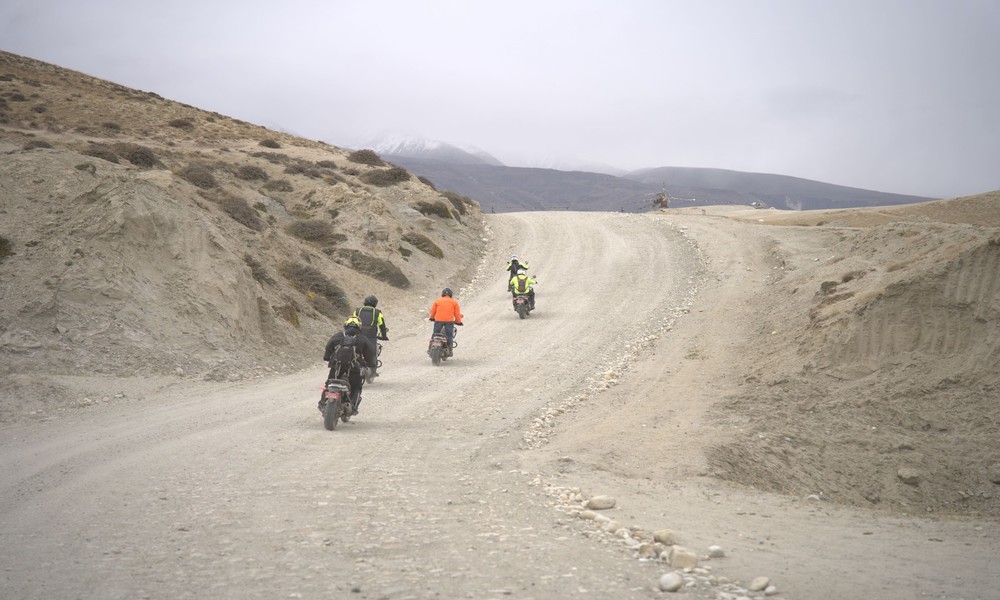
Travel guides are good at facts. Which road connects where. Which pass closes in which month. Which guesthouse has hot water above 3,000 metres. What they cannot carry is the living texture of how roads in Nepal actually work, the unwritten code that governs every interaction between vehicles, animals, pedestrians, and the road surface itself. That code is learned by riding, not by reading. Here is what it taught me.
The Horn Is Not Aggression – It Is Conversation
The first thing that disorients a rider arriving in Nepal from a European or North American context is the constant, cheerful, entirely non-aggressive use of the horn. Trucks blast it approaching blind corners. Motorcycles tap it passing through villages. Tempo vans announce their presence on narrow hill roads with sustained honking that would constitute road rage anywhere else.
It took three days of riding before I understood what was actually happening. The horn in Nepal is not a weapon. It is a communication tool – the acoustic equivalent of eye contact in a social interaction. It says: I am here, I am moving, here is my approximate size and speed and intention. On roads where sightlines are measured in metres and the oncoming lane can contain anything from a loaded truck to a grazing yak, this constant acoustic conversation is not noise pollution. It is the road’s nervous system.
Once I understood this, I started using my horn the same way – lightly, informatively, without frustration. The road immediately made more sense. I was no longer a passive observer of chaos. I was participating in a system.
Patience Is Infrastructure
In countries where roads are well-maintained and traffic is managed by signals and lane markings, patience is a virtue – nice to have but not structurally required. In Nepal, patience is load-bearing. It is as essential to getting anywhere as fuel.
A landslide debris field that blocks a mountain road does not generate the gridlocked honking and frustrated manoeuvres that the same obstruction would produce elsewhere. What happens instead is a collective, almost companionable settling-in. Engines stop. Tea appears from somewhere. Information moves through the waiting group – a woman who spoke to a truck driver who came from the other direction, who estimates three hours. Someone shares biscuits. A child appears and becomes briefly famous among the waiting riders.
The road culture treats delay not as a theft of time but as a condition of the landscape – something that happens, that will end, that is best navigated with company and without resistance. I rode into my first such delay with a European relationship to schedule still fully intact. I rode out of it, three hours later, having shared a meal with four strangers and learned more about the road ahead than any map would have shown me.
The Road Belongs to Everyone, Ranked by Size
Nepal’s road hierarchy is not posted anywhere. It does not need to be. It is understood by everyone who uses the roads and operates with remarkable consistency across the country.
The ranking, from most to least road authority, runs approximately as follows: loaded trucks, empty trucks, buses, tempo vans, jeeps and SUVs, motorcycles, pedestrians, cyclists, and then, occupying a sovereign category entirely outside the vehicular hierarchy – animals. A cow standing in the road outside Besi Sahar is not an obstacle. It is the road’s current landlord, and you wait until it decides to move.
What struck me was not the hierarchy itself but how smoothly it operates without enforcement. Motorcycles yield to jeeps not because jeeps are more aggressive but because everyone has internalised the physics of the situation – the jeep has less room to manoeuvre, less ability to stop, and more consequence if something goes wrong. Deference makes practical sense, and practical sense governs Nepalese road culture with a directness that formal rules rarely achieve.
Strangers Will Help You Before You Ask
The moment a motorcycle stops by the side of a Nepal mountain road, help begins arriving. Not dramatically,a passing rider slows to check. A tea house owner appears in a doorway. A farmer walking the opposite direction doubles back. Nobody waits to be asked. And this is one of the best parts of a motorcycle tour in Nepal.
This reflexive roadside solidarity is the road culture’s most quietly extraordinary feature. It is extended without calculation, without expectation of return, and with a practical competence – local knowledge of the terrain, familiarity with the mechanical problems most common on that stretch of road – that formal assistance could not replicate. It saved my journey twice. It cost the people who offered it nothing, and they seemed genuinely puzzled that I found it remarkable.
It is, I eventually understood, simply what the road asks of everyone who uses it. The road is hard. People help each other. The rest is detail.
The Last Thing Nepal’s Roads Teach
No travel guide captures what the road gives you when you stop fighting its terms and accept them. The schedule you release. The efficiency you abandon. The patience you build not because someone recommended it but because the mountain in front of you requires it and there is no negotiating with a mountain.
Nepal’s road culture does not accommodate the traveller who arrives with a fixed relationship to time, control, and predictability. It accommodates – with extraordinary warmth – the traveller who is willing to learn a different set of rules. The reward for that willingness is not just easier travel. It is a different quality of attention to the world moving past you.
That is the thing no guide could have told me. You have to ride into it to find it.
