
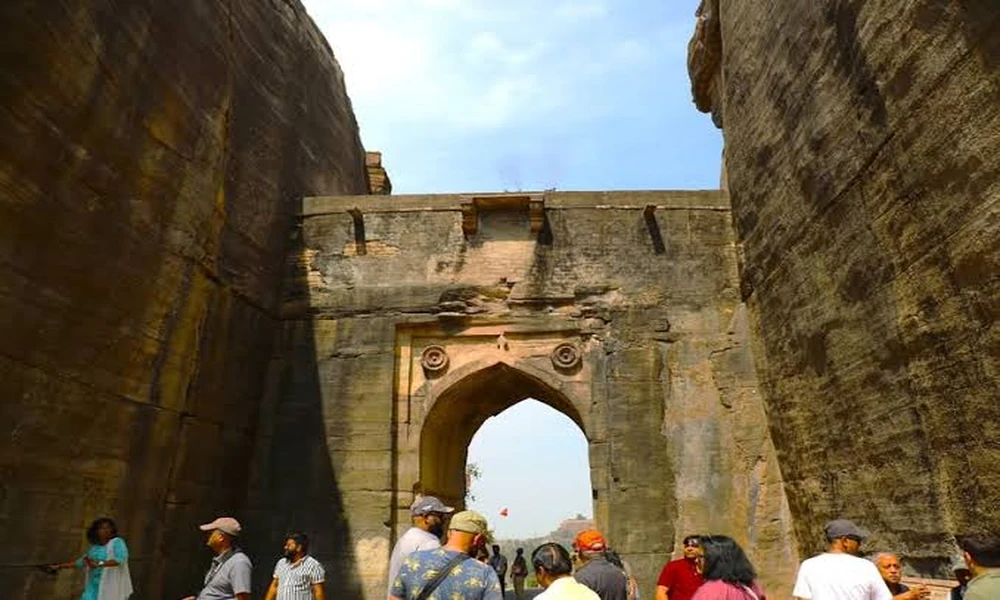
Chanderi had a certain charm that made leaving the car behind feel quite natural. As soon as I wandered into the town’s ancient lanes, it became quite clear that the town was impossibly intricate to fully experience from a car window. I saw stone walls, little courtyards, historical gates, and heard occasional sounds of a hand loom weaving near the corners.
Throughout my journey, I noticed how walking changed the way I saw all sights. I could stop at any interesting place, talk to locals, and take detours without worrying about directions and parking.
Why I chose to walk instead of drive in Chanderi
Chanderi is a very compact town, designed with walkers in mind rather than drivers. Its streets are narrow and bumpy, and sometimes cars can’t move through. Since my first morning in the town, I decided to leave my car at the hotel and explore everything on foot.
Chanderi’s old fort watching over the town
The Kirti Durg fort sits on a hill above Chanderi, overlooking the entire town below. It was built centuries ago and has seen several rulers come and go. I climbed up early in the morning, before the heat set in. From the top, the rooftops and domes of Chanderi looked like they belonged to a much older century.
Getting lost near Chanderi’s Jama Masjid
Jama Masjid in Chanderi is considered one of the region’s ancient mosques due to its charm. The street curls around the mosque, causing foreigners to lose their sense of direction. I spent almost an hour wandering without checking my position.
The sound of looms behind Chanderi’s closed doors
Chanderi is famous for its handwoven sarees, and the industry still exists. Almost every street in Chanderi echoes the low sound of looms working inside. I halted near an open door and noticed a weaver silently working at his loom.
Finding hotels in Chanderi close to the old town
Staying at the hotels near the old town hastens the walking and saves time on transport. We stayed at one of the hotels in Chanderi and could reach the market or the fort road on foot. It meant we could go out early in the morning, come back for breakfast, and leave for a fresh exploration without a vehicle.
The Chanderi stepwells that most visitors skip
Chanderi has lots of ancient stepwells called baolis. Most tourists go to the fort but never experience what it is like to be in a stepwell. I discovered one of the stepwells situated behind the residential streets, with steps worn by time.
Chanderi’s Battisi Baodi and its layered history
Battisi Baodi is one of the most famous stepwells. Locals told me it was used as a water source and a cool place in warm weather. By looking inside the stepwell, I could understand how people lived in the past centuries.
What slowing down actually taught me in Chanderi
Chanderi is not a place that rewards a rushed itinerary. The town reveals itself in detail: a carved doorway here, a faded fresco there, a stepwell hidden behind a wall. Walking slowly meant noticing things a quick drive-through would have completely missed. It also meant talking to more people than I usually do while travelling.
What I would tell anyone visiting Chanderi
Make sure that your first day is free of any itinerary. Instead of following a map, walk wherever the roads will take you. Visit the step wells in the first hour of the day, when the light and the town create the best ambience. Talk to weavers if they are open to conversation, as their stories are as colourful as their cloth.
Final thoughts
Having returned from my exploration journeys, I finally understood why Chanderi is different from many other historical towns. There is no emphasis on great relics of the past. History can still be traced along streets, houses, production workshops, markets, and other ancient constructions. The fort provided good views, but the smaller sights often attracted my attention even more. Walking on foot allowed me to notice many minor features of the town that were as interesting as the famous sights.
